
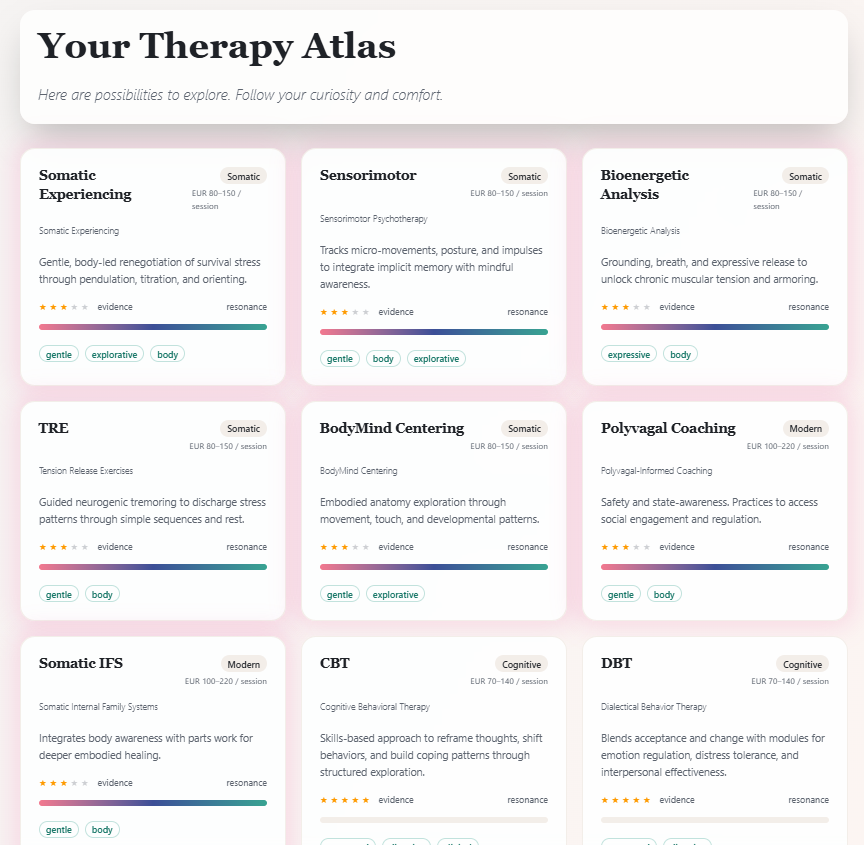
Therapy Atlas was conceived as a gentler alternative to clinical intake forms and algorithmic therapist directories — a poetic, trauma-sensitive space where people can translate their symptoms, body sensations, and history into a clear map of therapies that might genuinely fit. The experience guides users through a calm, conversational questionnaire and then synthesizes their answers into a personalised “atlas” of modalities—somatic, cognitive, and integrative—each explained in plain language with resonance cues and cost ranges, offering options to explore rather than diagnoses or prescriptions.
People looking for therapy—especially with complex or body-held trauma—are overwhelmed by jargon, clinical intake forms, and thousands of modalities that all sound the same. They often end up in mismatched therapies that feel unsafe or ineffective because there’s no gentle, embodied way to understand what might actually fit them.
I mapped common symptoms, body sensations, histories, and therapy “vibes” into a shared language, then paired that with research on somatic and cognitive modalities to define a high-level matching model. From there I prototyped a step-by-step, trauma-sensitive flow—testing tone, questions, and visual hierarchy—to ensure every screen felt like a calm conversation, not an assessment, and culminated in a clear “therapy atlas” of options rather than a diagnosis.
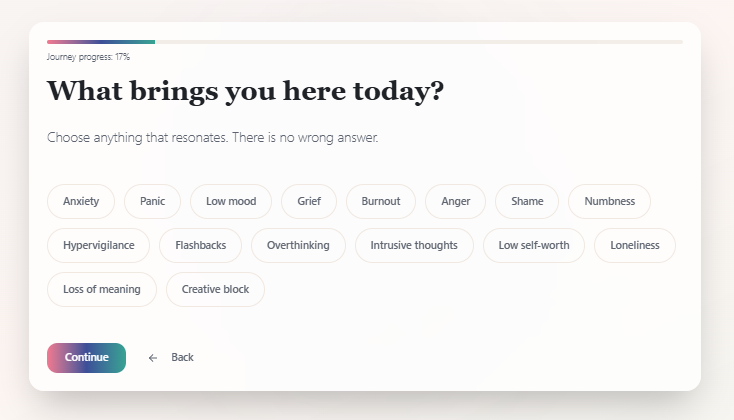
Overwhelm & jargon fatigue – Translated clinical language into warm, plain-English prompts and microcopy that feel like a conversation, not an assessment.
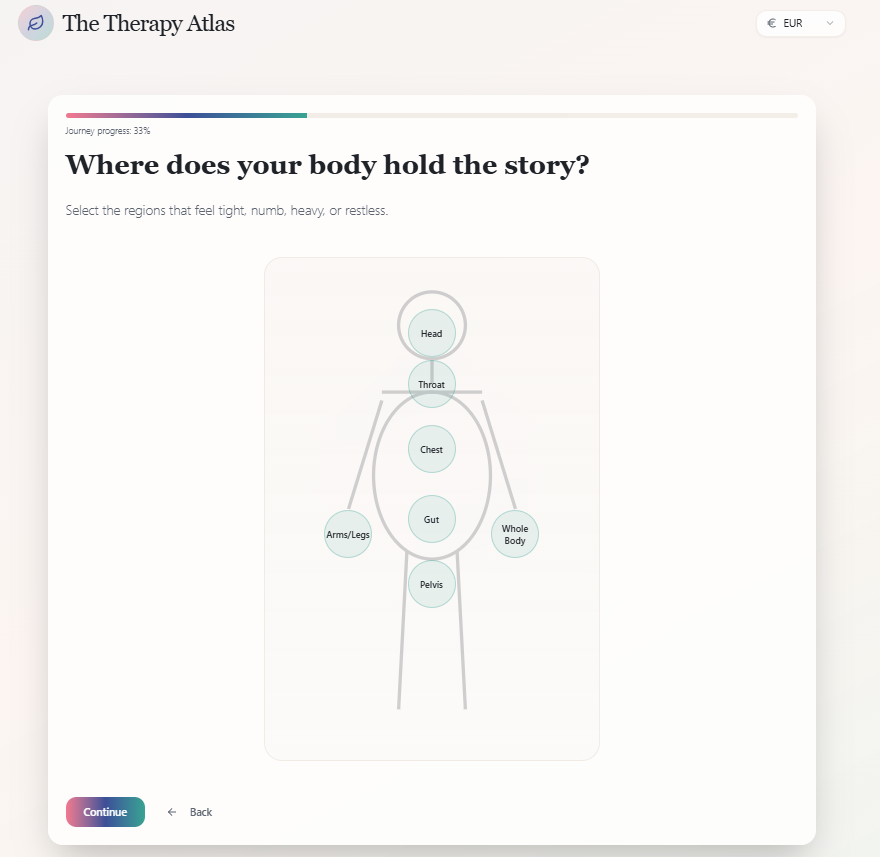
Disconnection from the body – Introduced an interactive body map so users can locate tension, numbness, and pain as part of their narrative, not as an afterthought.
Fear of being pathologized – Framed every step around “what to honour” and “what brings you here” instead of diagnoses or labels; repeated safety disclaimers.
Therapy choice paralysis – Collapsed dozens of modalities into a shared attribute model (somatic vs cognitive, gentle vs directive, depth vs skills) and surfaced only a curated set of matches.
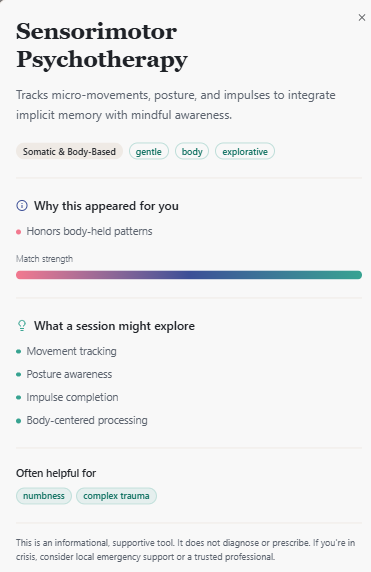
Mistrust of “magic matching” – Exposed “Why this appeared for you” on each modality card so users see the link between their inputs and the suggested approaches.
Defined per-modality profiles along the same dimensions plus typical use cases (e.g. “numbness”, “complex trauma”, “panic”, “relational wounds”).
Built a simple scoring engine that aggregates user weights, scores each modality, and ranks them by “resonance” rather than probability or diagnosis.
Added guardrails to avoid over-narrowing: always surface a mix of somatic and cognitive options, plus at least one lower-intensity choice.
Each Therapy Atlas card displays:
Modality detail views expand with:
A soft reminder: “Informational only – not diagnosis or prescription.”
Each “user journey” record internally includes:
Each modality record includes:
Curious about collaborating, commissions, or creative partnerships? I’d love to hear what you’re dreaming up.
![image of writing on notepad (for a financial advisor) [image 4]](https://cdn.prod.website-files.com/68932a2f93d6fa07de373586/69304a62e1a76ce9c803356c_ta6.png)
Development ready mobile version.